How Was the Family Code in Algeria Amended
Why practice women still change their names?
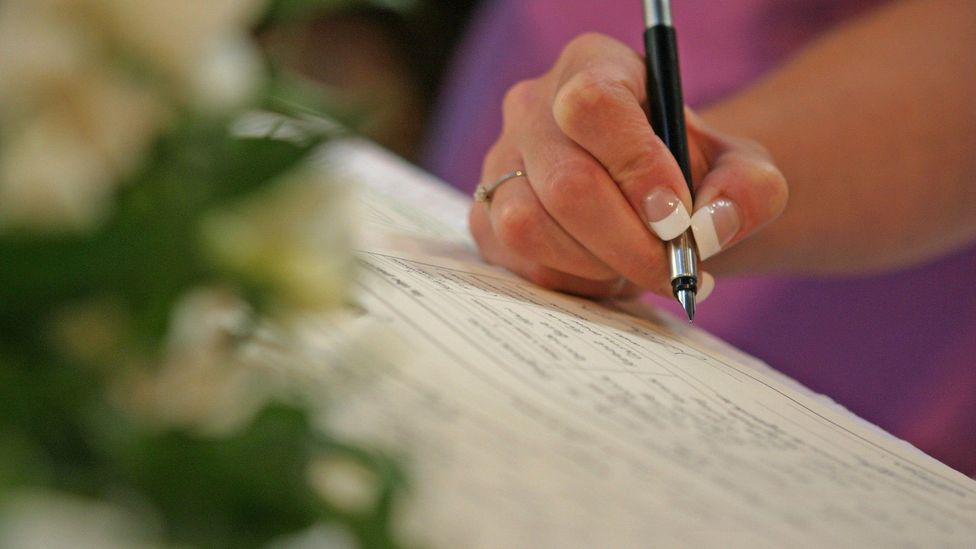
Taking a married man's name emerged from patriarchal history. Then why exercise so many young western couples notwithstanding follow the tradition?
P
Planning a nuptials during a pandemic is riddled with uncertainties, but for 30-year-old Lindsey Evans, there's ane thing she's articulate near. "The closer we get to the wedding, the more positive I am that I want to take his concluding name," says the Californian, who runs a lifestyle-media company with her partner and is due to tie the knot in July 2021.
In the US, most women adopt their husband'south family name when they get married – effectually 70%, according to one of the largest data analyses in recent years. For British women, the figure is almost 90%, co-ordinate to a 2016 survey, with around 85% of those aged between eighteen and xxx maxim they still follow the practise. Although these figures are lower than they were a generation ago, it's clear information technology remains a strong cultural norm in large parts of the western world, despite today's more than individualistic and gender aware era. While definitions of feminism vary, 68% of women under 30 describe themselves every bit feminists in the US and around 60% in the UK.
"Information technology is quite surprising... [so many women adopt the man's name] since information technology comes from patriarchal history, from the thought that a woman, on marriage, became one of the man's possessions," says Simon Duncan, a professor in family life at the Academy of Bradford, UK, who has been researching the do of male person proper name-taking. He describes the tradition equally "entrenched" in most English-speaking countries, even though the concept of "owning" wives was scrapped more a century ago in Great britain, and there is currently no legal requirement to take a man's proper noun.
Much of western Europe also follows the same pattern (notable exceptions include Spain and Iceland, where women tend to go on their birth names when they marry, and Greece, which has made it a legal requirement for wives to retain their names for life since 1983). Even in Norway, which is regularly ranked one of the top countries for gender equality and has a less overtly patriarchal history, the bulk of married women still take their husband's name. There, notwithstanding, around one-half of name-takers keep their maiden proper noun as a middle proper noun, which functions as a secondary surname.
"The question remains... is this just a harmless tradition, or is there some sort of meaning leaking from those times to now?" asks Duncan, who recently teamed up with academics at the University of Oslo and the Academy of the West of England to delve into the reasons for its persistence.
There are, of grade, numerous personal reasons a adult female might want to lose her maiden name, from disliking how it sounds, to wanting to disassociate herself from absent-minded or abusive family members. But through an in-depth analysis of existing research, and detailed interviews with newly married and engaged couples in the Great britain and Kingdom of norway, Duncan's team identified two core motivators driving the tradition. The offset was the persistence of patriarchal ability (whether that was obvious to the couples or not). The second was the ideal of the 'good family' – the sense that having the same name as your partner symbolises commitment, and this ties you and any potential children together as a unit.
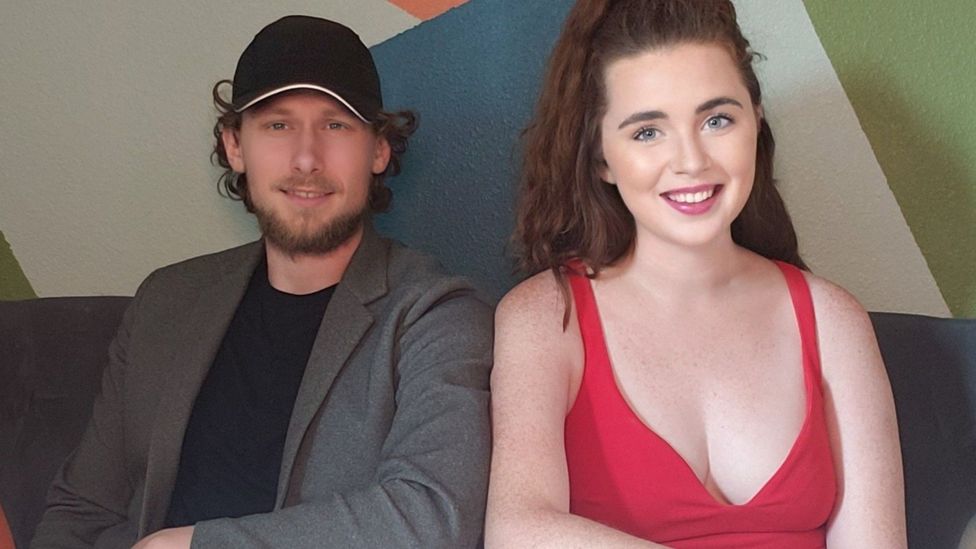
Lindsey Evans says she wants to change her proper noun - and that the decision came from her
Some couples uncritically accustomed the practice because it was conventional, while others actively embraced the idea of passing on male person names. "Some men still insisted on it – the reproduction of that sort of patriarchal assumption from the past," says Duncan. "Some women go along with that or internalise that. Then, we constitute people who say they are actually looking frontward to being a 'Mrs' and changing their identity to that of their husband."
His team'southward enquiry paper suggests that women irresolute their names is, unsurprisingly, continued to the survival of other patriarchal traditions, such as fathers giving abroad brides and men being more than likely to propose. Duncan says that these elements have come to class part of the optimum "union package" for many couples.
"Information technology'southward role of the romance," agrees Corinna Hirsch, a German language marketer living in Stockholm, who took her husband's last name when they married terminal twelvemonth. "We slept in separate rooms the evening before the wedding. I had something old, blue, borrowed and new. My dad and husband gave a speech, simply I didn't." She believes these traditions helped her and her partner develop a deeper bail, even later on more than eight years together. "We didn't expect that we would feel any closer after the wedding, simply I think having this big wedding ceremony and having one concluding name did the fob."
The second core trend observed by Duncan's team is more about public perceptions. They concluded that taking on a partner'southward name remains seen equally a mode to display your commitment and unity to the outside globe.
"I feel like it gives the states an identity as a family and not merely individuals," agrees Lindsey Evans in California. "Nosotros have our own first and eye names, which make usa our own people, but having a articulation final name makes united states of america more of a unit of measurement."
Duncan'southward research establish this 'skilful family' narrative was especially stiff among women who'd had children. Even some of those who initially declined to adopt their male partner'south family name upon marriage switched their approach after giving birth.
The researchers institute the 'good family unit' narrative was a key factor in women irresolute their names
"I wanted to do it to have a better connection with my kid, not just in a loving relationship blazon of way, simply on paper," reflects Jamie Berg, a US-born dancer and gymnast living in Oslo. Later keeping her own proper noun for several years, largely because it was important for her professional person identity, she added her husband'due south name to her passport and other formal documents when her son was born, "and then all three of us would accept the same final name". This, she hoped, would besides avoid administrative hassle, for case when travelling abroad with her kid.
Duncan's study highlighted another mutual feeling among many parents, that children might cease up confused or unhappy every bit a event of parents having different names. But he argues that while nonconformity can create adult discomfort, sociological research suggests a limited touch on on children, with most not confused about who's in their family, regardless of their surname.
Academics are split on how the name-changing norm plays against a backdrop of efforts to achieve gender equality.
Duncan describes it as "quite unsafe" – whether the couples doing information technology are actively embracing the tradition, or simply observing information technology by default. "It perpetuates the idea that the hubby'southward in authority... reproducing the tradition that the homo is the head of the household," he says.
That argument is strongly supported past women like Nikki Hesford, a business possessor from northern England. She is now divorced, simply refused to have her former husband's proper noun when they got married, and says she's shocked how few wives do the aforementioned.
"Women complain that they end upwards being the primary caregiver, the one who has to leave work when a kid is sick, the one who had to become to hospital appointments, the one whose career suffers... only they've set that precedent at the start by saying: 'You're more than important than me, you're the primary and I'grand the secondary,'" she argues. "Some people say: 'You're overthinking it, it'due south just nice tradition and it doesn't really mean annihilation', and I disagree."
Even so, Hilda Shush, an Irish gaelic couples counsellor and psychotherapist based in London, believes that women who reject proper noun-taking shouldn't be also quick to judge others. She notes that "former-fashioned romance" concepts, long reinforced by film, literature and magazines, have go amplified in an age of social media. This means women proceed to be influenced by these kinds of messages, despite more gender-positive, feminist perspectives being given a greater platform. "For so many influencers, it's very much office of their message or their profile, this whole narrative around a boyfriend and so the huge appointment, the honeymoon," argues Burke. "Even if those women are kind of identifying as a feminist, that kind of lifestyle that they're portraying is very much a sort of romantic ideal."
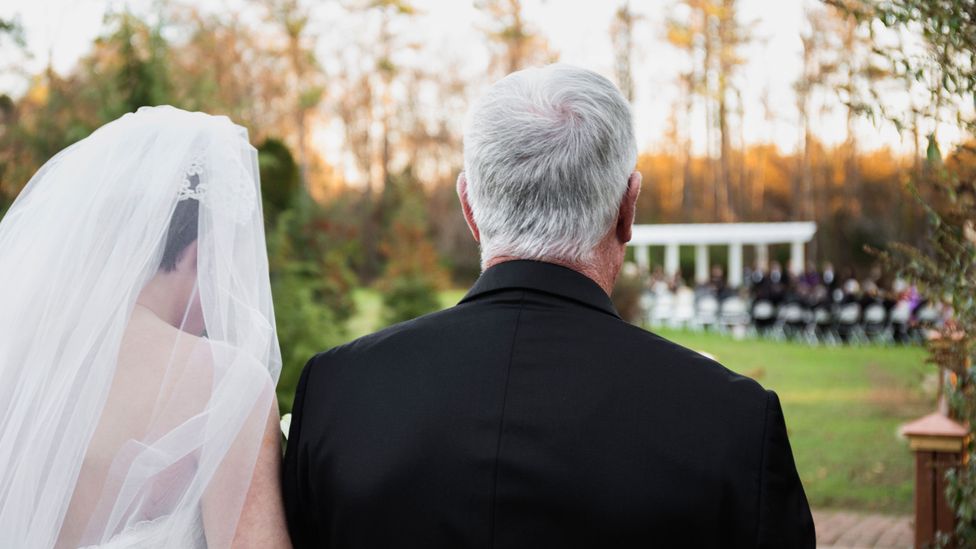
Hilda Burke suggests name-changing remains part of the traditional matrimony narrative romanticised on social media
She says that for many, switching to their husband's family name is also a pragmatic selection – for example, to appease older relatives or avoid having to explain themselves at the school playground – and doesn't hateful that these women aren't pushing for gender equality. "This is an case of the dissonance of having maybe a principle, having a feminist ideal, but then getting downward to the nitty gritty of daily life," she says. "They'd say: 'Y'all know what? I'm notwithstanding working. I'm nevertheless getting promoted. I haven't given up. So, you know what? On the bigger scale, I'g still feminist'."
Another statement is that feminism is ultimately almost giving women free choice. This means equally long as they tin can determine what proper noun they'd like (rather than it existence forced on them by their partner or gild), it shouldn't affair whether that is in keeping with, or going against, patriarchal norms.
"He never told me: 'I demand you to accept my concluding proper name', but instead I was the ane who brought it to the table," says Evans in California. "Equally a feminist, I am able to make the conclusion that is best for me without worrying most gender roles."
How prevalent the male name-taking tradition will remain in the future is hotly debated by researchers. There is little predictive academic research, although there are signs that - despite the slow progress to date - both women and men are condign increasingly open up to alternatives.
In the Uk, a 2016 YouGov poll of more than 1,500 people showed that 59% of women would still like to take their spouse's surname upon marriage – and 61% of men however desire them to do so. Although these figures are high, they're around 30% lower than the proportion of Britons who currently go through with the tradition. A split survey showed that xi% of xviii-to-34-year-olds in the UK are now double-barrelling their surnames when they get married. This practice was traditionally the preserve of upper-class British families, simply gender equality is emerging as a motivator within couples with more diverse backgrounds.
"We talked about it beforehand and decided that because we shared everything else in our lives it fabricated sense to share names as well," explains Nick Nilsson-Edible bean, a British communications manager living in Malmö, in southern Sweden, who has the same double-barrelled surname every bit his wife. "It felt a flake archaic and onetime fashioned to merely take my name."
In the U.s., growing numbers of women are too opting for unhyphenated double surnames due to the demand to remain searchable online for professional person reasons. Meanwhile, some couples blend their names or come up up with new ones to share, and some men adopt their wives' names, although both phenomena remain unusual.
"I wasn't hung up on all the masculinity and patriarchal [rubbish], and I knew how important my wife's identity was to her," says Ciaran McQuaid, a 39-yr-quondam British engineer who is one of the rare few to switch to his wife'southward name. "I work within the construction manufacture and I accept to deal with quite manlike attitudes, only I'thousand not the type of person who gets bothered by information technology."
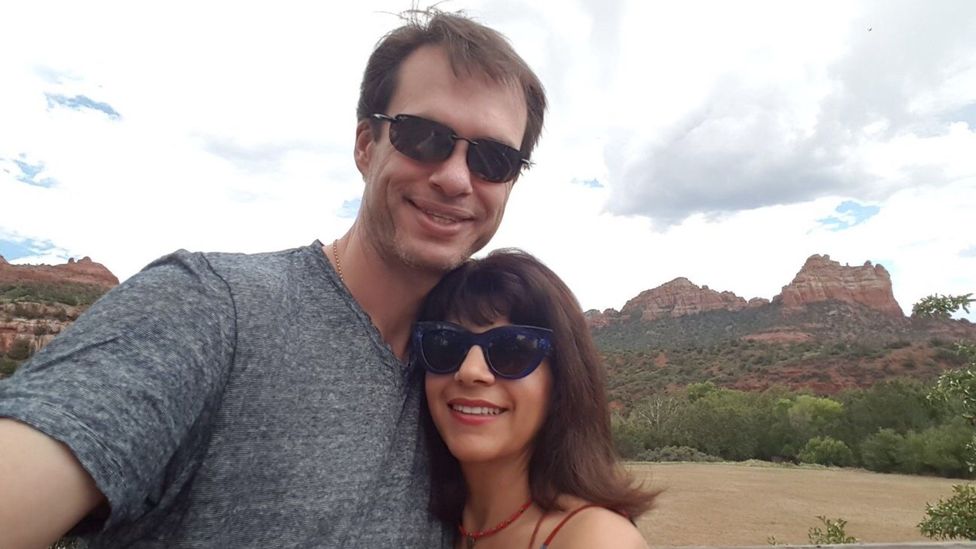
America Nazar says changing her name would have caused an atrocious lot of unnecessary admin
With women tending to ally later on – the boilerplate age is now 35 or older in European countries including the Great britain, Italy and Spain, and around 28 in the US – this may besides have an affect on futurity name choices. Research from Norway and the US suggests that older, more educated and economically independent women are more likely to go on their birth names, while the exercise is less pop with younger, lower-paid women and within the African-American community.
"I already owned my house. I had a caste, my machine, all unlike things. So, if I had to change my name, then after I'd take to change my proper name on all those titles and licenses," explains America Nazar, a dentist based north of Oslo, who didn't switch her proper noun when she got married last year. "It just makes it a fleck more complicated and it's non very necessary, in my stance."
Other researchers point to the influence of the LGBTQIA community, where at that place already tends to exist more flexibility around name changing. Dr Heath Schechinger, a psychologist and therapist with a clinical mail at the University of California, Berkley, predicts that heterosexual couples may be encouraged to continue their own names as "the concept of 'family' expands" to include more LGBTQIA and even "two-plus partner unions", making information technology more common to suspension traditional norms. "While it is unlikely partners will e'er have consummate autonomy nigh their name choices without fright of societal or familial repercussions, an increasing number of people are, and will go along, to make the choice to deviate from the norm," he argues.
"It'southward time for this to become an open-ended discussion within partnerships, and not something that is assumed or pre-determined," agrees marketing manager Verity Sessions, from Brighton, England, who kept her own proper name when she married her wife Alice Maplesden. "Some of my male friends have decided to accept their wife'southward family name and I love them for that," she says. Nevertheless, she says she understands that other couples "do just love a tradition" or might opt for naming conventions that but "make a family tree a bit easier to work out".
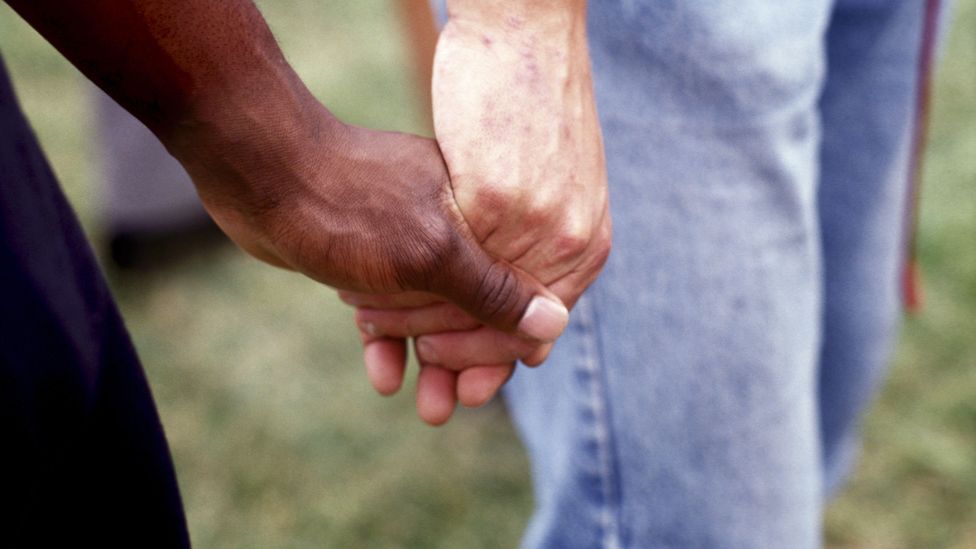
As the concept of family unit evolves, more people volition brand decisions that piece of work for them, some experts say
In London, psychotherapist Burke also believes that more diverse naming conventions will beginning to bleed into society. Simply as women go on to battle for equal pay, and are more than probable to be facing job insecurity and performing more childcare as a effect of Covid-19, she argues that many "people experience similar there are other battles that are more than of import right now". "It is going to come in time, when other things are fabricated more equal."
Fans of the male name tradition like Corinna Hirsch, however, hope it won't die out. "It would be nice if [it] continues, but only if it'southward not forced," she says. "You like traditions because they make you feel all warm and fuzzy? Go for information technology."
Source: https://www.bbc.com/worklife/article/20200921-why-do-women-still-change-their-names
0 Response to "How Was the Family Code in Algeria Amended"
Post a Comment