Everything You Need to Know About Access Control Lists
In the calculator networking earth, an ACL is ane of the most fundamental components of security.
An Access Command Lists "ACL" is a role that watches incoming and approachable traffic and compares it with a set up of defined statements.
In this article, nosotros volition go deep into the functionality of ACLs, and reply the post-obit common questions about ACLs?
- What is an Access Command List?
- Why Use An ACL?
- Where Can You Place An ACL?
- What Are The Components of An ACL?
- What Are The Types of ACLs?
- How to Implement An ACL on a Router?
What is an Access Control List?
Access Command Lists "ACLs" are network traffic filters that can control incoming or approachable traffic.
ACLs piece of work on a prepare of rules that ascertain how to forward or block a packet at the router'southward interface.
An ACL is the aforementioned as a Stateless Firewall, which only restricts, blocks, or allows the packets that are flowing from source to destination.
When you lot define an ACL on a routing device for a specific interface, all the traffic flowing through will be compared with the ACL statement which volition either block it or allow it.
The criteria for defining the ACL rules could exist the source, the destination, a specific protocol, or more data.
ACLs are common in routers or firewalls, only they can also configure them in any device that runs in the network, from hosts, network devices, servers, etc.
Why Use An ACL?
The main idea of using an ACL is to provide security to your network. Without it, any traffic is either immune to enter or exit, making it more than vulnerable to unwanted and dangerous traffic.
To improve security with an ACL you can, for example, deny specific routing updates or provide traffic flow control.
Equally shown in the movie beneath, the routing device has an ACL that is denying access to host C into the Fiscal network, and at the same fourth dimension, it is allowing admission to host D.
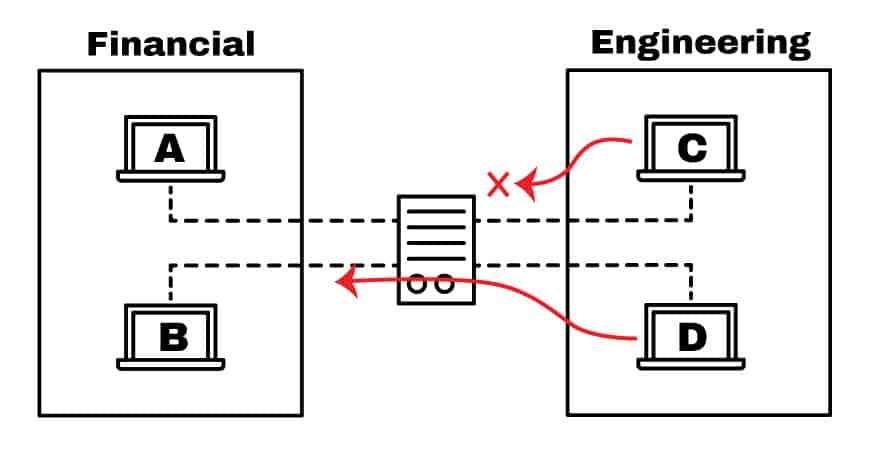
With an ACL you lot tin can filter packets for a single or group of IP address or different protocols, such as TCP or UDP.
So for instance, instead of blocking merely one host in the engineering team, yous tin can deny access to the entire network and but allow ane. Or yous tin also restrict the access to host C.
If the Engineer from host C, needs to admission a web server located in the Financial network, you can simply permit port 80, and block everything else.
Where Can You Identify An ACL?
The devices that are facing unknown external networks, such equally the Internet, need to have a way to filter traffic. So, one of the best places to configure an ACL is on the border routers.
A routing device with an ACL can be placed facing the Net and connecting the DMZ (De-Militarized Zone), which is a buffer zone that divides the public Internet and the individual network.
The DMZ is reserved for servers that demand access from the outside, such equally Web Servers, app servers, DNS servers, VPNs, etc.
As shown in the picture below, the design shows a DMZ divided by ii devices, one that separates the trusted zone from the DMZ and another that separates information technology with the Internet (public network).
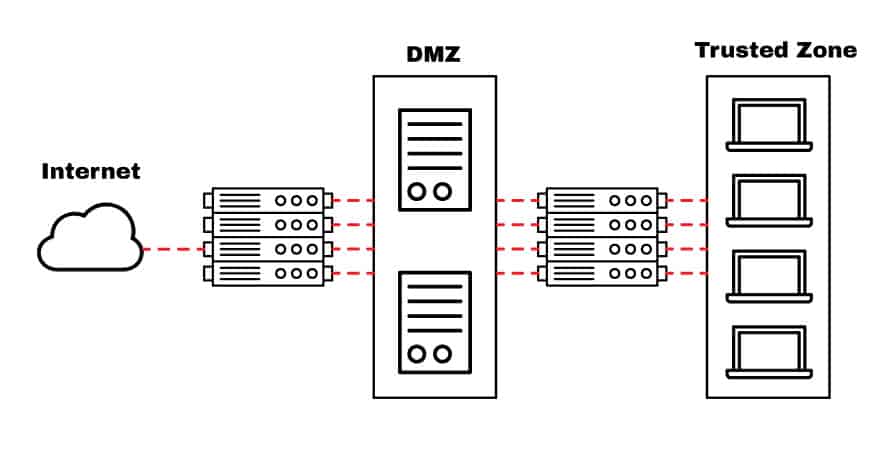
The router facing the Cyberspace acts as a gateway for all exterior networks. It provides general security by blocking larger subnets from going out or in.
You lot tin too configure an ACL in this router to protect against specific well-known ports (TCP or UDP).
The internal router, located betwixt the DMZ and the Trusted Zone, tin be configured with more restrictive rules to protect the internal network. Withal, this is a great identify to choose a stateful firewall over an ACL.
But Why is information technology Ameliorate to identify an ACL vs. Stateful Firewall to protect the DMZ?
ACLs are directly configured in a device'due south forwarding hardware, so they do not compromise the end performance.
Placing a stateful firewall to protect a DMZ tin can compromise your network'southward performance.
Choosing an ACL router to protect high-performance assets, such as applications or servers can be a amend choice. While ACLs might not provide the level of security that a stateful firewall offer, they are optimal for endpoints in the network that demand loftier speed and necessary protection.
What Are The Components of An ACL?
The implementation for ACLs is pretty like in most routing platforms, all of which have general guidelines for configuring them.
Think that an ACL is a gear up of rules or entries. You can have an ACL with single or multiple entries, where each one is supposed to do something, it can be to allow everything or block nix.
When you lot define an ACL entry, y'all'll need necessary information.
- Sequence Number:
Identify an ACL entry using a number. - ACL Name:
Define an ACL entry using a proper name. Instead of using a sequence of numbers, some routers permit a combination of letters and numbers. - Remark:
Some Routers permit y'all to add comments into an ACL, which can assist you to add detailed descriptions. - Statement:
Deny or let a specific source based on address and wildcard mask. Some routing devices, such as Cisco, configure an implicit deny statement at the end of each ACL past default. - Network Protocol:
Specify whether deny/permit IP, IPX, ICMP, TCP, UDP, NetBIOS, and more. - Source or Destination:
Define the Source or Destination target as a Single IP, a Accost Range (CIDR), or all Addresses. - Log:
Some devices are capable of keeping logs when ACL matches are plant. - Other Criteria:
Advanced ACLs permit you to use control traffic through the Type of Service (ToS), IP precedence, and differentiated services codepoint (DSCP) priority.
What Are The Types of ACLs?
There are four types of ACLs that you tin use for different purposes, these are standard, extended, dynamic, reflexive, and time-based ACLs.
ane. Standard ACL
The standard ACL aims to protect a network using simply the source accost.
It is the nearly basic blazon and tin can be used for simple deployments, just unfortunately, information technology does not provide strong security. The configuration for a standard ACL on a Cisco router is as follows:

2. Extended ACL
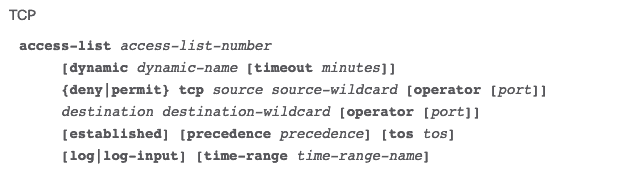
With the extended ACL, yous tin also block source and destination for single hosts or unabridged networks.
You can too utilise an extended ACL to filter traffic based on protocol information (IP, ICMP, TCP, UDP).
The configuration of an extended ACL in a Cisco router for TCP is as follows:
iii. Dynamic ACL
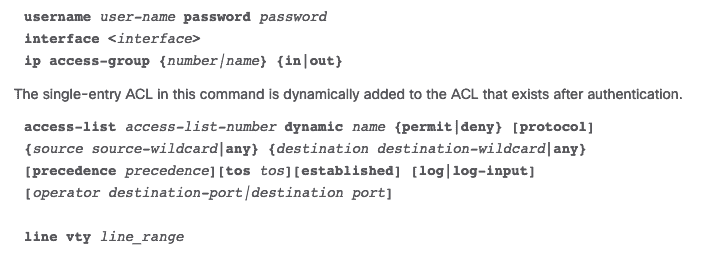
Dynamic ACLs, rely upon extended ACLs, Telnet, and authentication. This blazon of ACLs are often referred to as "Lock and Central" and tin can be used for specific timeframes.
These lists allow access to a user to a source or destination only if the user authenticates to the device via Telnet.
The post-obit is the configuration of a Dynamic ACL in a Cisco router.
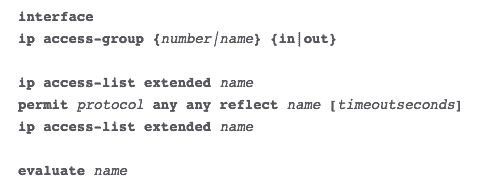
4. Reflexive ACL
Reflexive ACLs are also referred to every bit IP session ACLs. These type of ACLs, filter traffic based on upper layer session information.
They react to sessions originated inside the router to whether let outbound traffic or restrict incoming traffic. The router recognizes the outbound ACL traffic and creates a new ACL entry for the inbound.
When the session finishes, the entry is removed.
The configuration of a reflexive ACL in a Cisco router is every bit follows:
How to Implement An ACL On your Router?
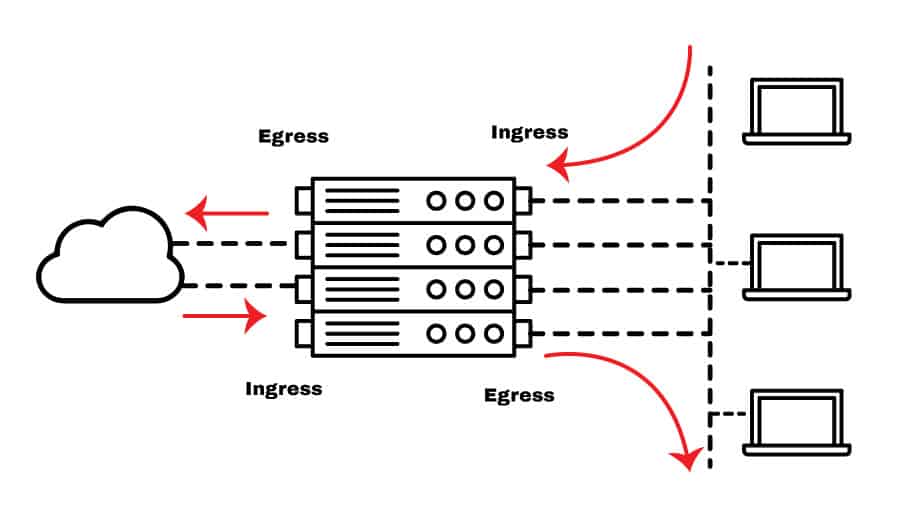
Understanding ingress and egress traffic (or entering and outbound) in a router, is critical for proper ACL implementation.
When setting rules for an ACL, all traffic flows are based on the point-of-view of the router'southward interface (not the other networks).
As y'all tin can encounter from the picture below, ingress traffic is the menstruum coming from a network, whether information technology is external or internal, into the router's interface. The egress traffic, on the other manus, is the flow from the interface going out into a network.
For an ACL to work, apply it to a router's interface. Since all routing and forwarding decisions are made from the router's hardware, the ACL statements can exist executed much faster.
When you create an ACL entry, the source address goes first, and the destination goes later on. Have the example of the extended ACL configuration for IP on a Cisco Router. When y'all create a Deny/Permit rule, you must starting time ascertain the source, and and then the destination IP.

The incoming flow is the source of all hosts or network, and the outgoing is the destination of all hosts and networks.
What is the Source if you want to Cake Traffic coming from the Net?
Remember that entering traffic is coming from the outside network to your router interface.
So the source is an IP address from the Internet (a web server public IP accost) or everything (wildcard mask of 0.0.0.0), and the destination is an internal IP accost.
On the opposite, what if you what to Block a Specific Host to connect to the Internet?
The inbound traffic is coming from the inside network to your router interface and going out to the Internet. So the source is the IP from the internal host, and the destination is the IP address on the Internet.
Summary
ACLs are the bundle filters of a network.
They tin can restrict, permit, or deny traffic which is essential for security. An ACL allows you to control the flow of packets for a unmarried or group of IP address or different for protocols, such equally TCP, UDP, ICMP, etc.
Placing an ACL on the incorrect interface or mistakenly irresolute source/destination can create a negative impact on the network. A single ACL statement can leave an entire business without the Net.
To avoid negative performance is critical to understand the inbound and outbound traffic flows, how ACLs piece of work, and where to identify them. Remember that a router's chore is to forward traffic through the right interface so that a flow tin can be either coming information technology (inbound) or going out (outbound).
Although a stateful firewall provides much better security, they can compromise the performance of the network. But an ACLs is deployed right on the interface, and the router uses its hardware capabilities to procedure it, making information technology much faster and yet giving a adept level of security.
Source: https://www.ittsystems.com/access-control-list-acl/
0 Response to "Everything You Need to Know About Access Control Lists"
Post a Comment